
· by Michael Blair, Nashville's Insulation
The three common insulations perform differently and suit different applications. Cost is the obvious difference: the Building America Solution Center’s comparison of vented and unvented attics notes that blown cellulose or fiberglass on an attic floor tends to cost less than the spray foam or foam board used to insulate along the roof. Air sealing is the more important difference, and it is where the three part ways.
Fiberglass
Fiberglass comes as batts or as loose fill blown in by machine. It insulates well when it sits at full loft with no gaps, and it does not stop air moving through it. The same vented-attic guide says air movement through insulation greatly reduces its effectiveness, which is why ENERGY STAR’s attic insulation project has the attic air sealed before any insulation is added, and why air sealing is a job of its own before the insulation goes in.
How it is put in decides how it performs. The Building America guide to batts in an existing vented attic defines professional installation as no gaps, no voids, no compression and no misalignment with the air barrier. A batt cut short at a joist, stuffed behind a wire or squashed flat under attic flooring breaks one of those rules, and the ceiling below it loses some of the performance the batt was rated for.
Blown cellulose
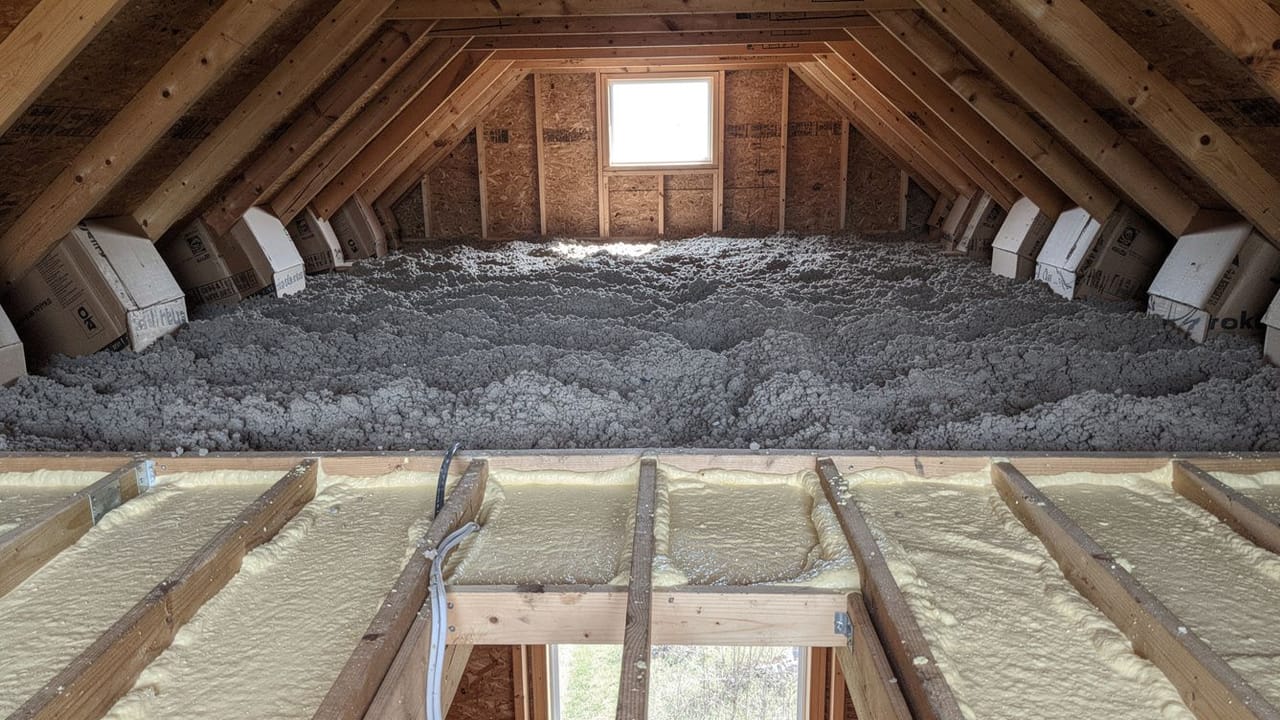
Cellulose is a loose fill, like blown fiberglass, and the Building America guide to blown insulation in an existing vented attic names both as the way to add insulation to an older house with little or none in the attic. That guide asks for it to fill every joist bay with no gaps or voids around wiring or piping and to cover the tops of the joists. It is not an air seal. The guide has the attic floor sealed first with sealant, one-part foam or rigid blocking, and that is the order we follow on a blown-in insulation job.
Loose fill settles. The vented versus unvented attic guide calls the loose fill in a vented attic susceptible to settling and warns that it can mean a significant loss of R-value, so the depth that counts is the depth after it settles. How deep that should be is the subject of our post on how much attic insulation a Nashville house needs. Foil comes into it only once that depth is reached, and our post on radiant barriers in a Nashville attic explains why we add a barrier after the insulation and never in place of it.
- Fiberglass: batts or blown, does not stop air, loses performance when gapped or compressed
- Cellulose: blown loose fill, fills joist bays around wiring, settles over time
- Open-cell foam: air seals, expands fast and far as it goes on
- Closed-cell foam: air seals, about two inches is typically a Class II vapor retarder
- Foam never goes over wet framing or under a leaking roof
Why choose spray foam over blown insulation?
Both kinds of spray foam insulate and air seal in the same pass, and the Building America guide to unvented attic insulation credits spray foam with the ability to air seal complex assemblies effectively. The guide to spray foam on an existing attic floor describes a hybrid: a layer of foam on the attic floor as the air barrier, with blown or batt insulation over it for depth. It names closed-cell as the preferred foam for that layer, because open-cell expands so quickly and so much that an unbroken layer is hard to get, and it notes that two inches of closed-cell is typically a Class II vapor retarder. That is a step below a Class I barrier such as polyethylene sheet, and our post on insulation, vapor and Middle Tennessee humidity explains where the distinction comes into play.
Older houses tend to leak. The Building America guide to foaming the cavities of existing exterior walls says older homes often have poorly insulated walls with numerous air leaks around piping, wiring holes and windows, and filling the opened cavities with foam insulates and seals them at once. Fiberglass and cellulose can reach the same R-value, but their air sealing has to happen as a separate step first. Where we recommend spray foam, that single step is the reason.
Where does spray foam need extra care?
It must not go over damp framing. The unvented attic guide calls for measuring the moisture content of the wood before spraying, to confirm it has dried to the level the foam maker recommends, and the guide to below-deck spray foam on existing roofs says to correct any roof leak and repair the damage first, and to consider replacing a roof near the end of its service life. Foam also hides the wood behind it: the vented versus unvented guide points out that a vented attic insulated at the floor makes roof leaks easier to find and fix. And on a roof deck it changes the ventilation strategy entirely. Foaming the deck makes an unvented attic, with the soffit and roof vents closed and sealed, and that has to be designed as one assembly under the code Metro enforces, which the Metro Nashville adopted codes list gives as the 2024 International Residential Code with local amendments.
The unvented attic guide says every unvented attic or cathedral ceiling has to provide either a very high degree of airtightness or a way to avoid condensation on cold surfaces, and the below-deck guide adds that some foams need a thermal or ignition barrier over them, depending on the product and the code. Foam sprayed on part of a roof deck with the soffit vents left open is neither a vented attic nor a properly built unvented one. Foam is a good product applied deliberately and a problem applied piecemeal. If you are weighing foam against blown insulation for your own attic, ask us for a free estimate and we will look at the roof and the framing before we suggest either.
Sources
- DOE Building America Solution Center, Vented versus Unvented Attic (2022) — Attic-floor fill tends to cost less than roof-line foam; air movement reduces insulation effectiveness; loose fill settles with significant R-value loss; vented attic makes roof leaks easier to find
- EPA ENERGY STAR, Attic Insulation Project — Air seal the attic before adding attic insulation
- DOE Building America Solution Center, Batt Insulation in Existing Vented Attics (2022) — Professional installation means no gaps, voids, compression or misalignment with air barriers
- DOE Building America Solution Center, Blown Insulation in Existing Vented Attic (2022) — Blown cellulose or fiberglass for older attics; fill every bay with no gaps around wiring; air seal the attic floor first; Class I barrier versus Class II retarder
- DOE Building America Solution Center, Unvented Attic Insulation (2022) — Spray foam air seals complex assemblies; close and seal all attic vents; measure wood moisture before spraying; airtightness or condensation control required
- DOE Building America Solution Center, Spray Foam Insulation Applied to Existing Attic Floor (2022) — Foam air barrier with blown or batt insulation over it; closed-cell preferred; open-cell expansion; two inches of closed-cell typically a Class II vapor retarder
- DOE Building America Solution Center, Spray Foam Insulation in Cavities of Existing Exterior Walls — Older walls with numerous air leaks; foam insulates and air seals the cavities at once
- DOE Building America Solution Center, Below-Deck Spray Foam Insulation for Existing Roofs (2020) — Fix roof leaks first; consider replacing a roof near end of life; block soffit vents; thermal or ignition barrier where required
- Metro Nashville Codes, Adopted Codes List — 2024 International Residential Code adopted with local amendments
FAQ
Spray Foam, Blown Cellulose or Fiberglass — questions
Is spray foam worth the extra cost?
Where air leakage is the main problem, as in an older house with leaky walls or a ceiling full of penetrations, foam insulates and air seals in one step and the cost is often justified. For simply adding depth over an attic floor that has already been air sealed, blown cellulose or fiberglass reaches the R-value and, according to the Building America Solution Center, attic-floor fill of that kind tends to cost less than foam.
Does cellulose insulation settle?
Yes. Loose-fill insulation, cellulose included, settles after it is blown, and Building America guidance says the settling can mean a significant loss of R-value. The depth that matters is the settled depth, so check the depth across the whole attic against the target rather than relying on the figure from the day it was installed.
Can I spray foam my attic roof deck?
Yes, but it turns the attic into an unvented one, which is a legitimate assembly that has to be designed as a whole. The soffit and roof vents are closed and sealed, the deck has to be dry and the roof sound before any foam goes on, and the foam has to be thick enough to control condensation under the code. Foam on the deck with the vents left open invites condensation problems.
What are the problems with spray foam insulation?
Most come from how it goes in. It must never go over damp framing, and it hides the wood, so roof leaks are harder to find. Sprayed on a roof deck it makes an unvented attic, which works only with the vents sealed and the assembly designed as a whole, and some foams need a thermal or ignition barrier.