
· by Michael Blair, Nashville's Insulation
The attic is where we start. ENERGY STAR’s guide to where sealing and insulating pays off most says the attic usually has the most potential for energy savings in a house and is typically accessible, and it says to always seal the attic before adding insulation. That is the order our attic insulation work follows on houses across Nashville and the towns around it.
Target depth
The target depends on the climate zone. ENERGY STAR’s table of recommended R-values asks for R60 in an uninsulated attic in zone 4A, or R49 where 3 to 4 inches are already down, and R49 or R38 in zone 3. The map printed with that table runs the line between those two zones through Middle Tennessee, so a house can sit on either side of it depending on the county, and working to the zone 4A row covers both.
Inches are easier to picture. The ENERGY STAR Home Upgrade page on attic insulation puts fiberglass, cellulose and mineral wool at about R-3 to R-3.5 per inch, which makes R49 somewhere around 14 to 16 inches of loose fill and R60 roughly 17 to 20. We set depth markers across the attic floor so the finished level can be checked later with nothing more than a flashlight.
Building code is a separate yardstick. Tennessee’s statewide energy code for one- and two-family homes has been the 2018 IECC with state amendments since July 16, 2020, according to the State Fire Marshal’s Office list of adopted codes, and the DOE Building Energy Codes Program’s Tennessee page rates that amended code as equivalent to the 2009 IECC. The ENERGY STAR figures are based on the 2021 edition.
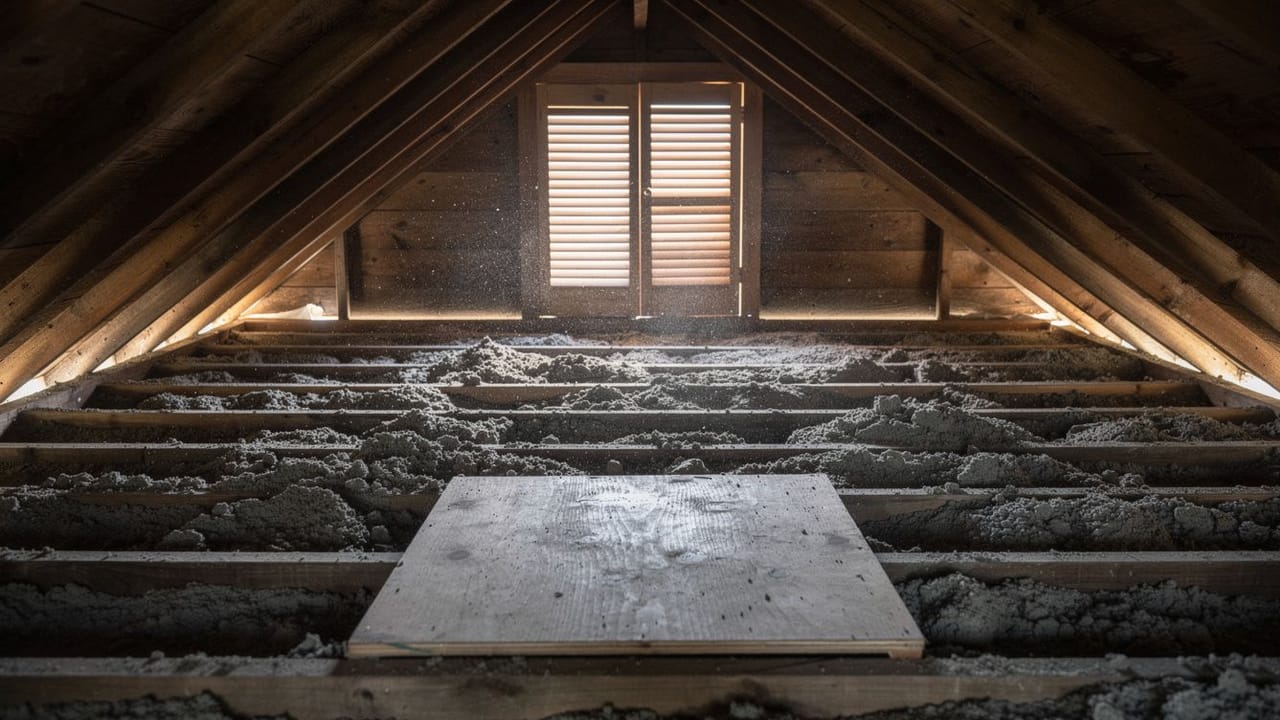
Checking your own attic takes a flashlight and a tape measure. ENERGY STAR’s rule of thumb is that insulation sitting at or below the level of the joists probably means you need more, and its shortcut for a rough R-value is the depth in inches multiplied by 3.
Air sealing first
ENERGY STAR defines R-value as a material’s ability to resist heat traveling through it. Air finding its way past the insulation is a separate problem: a DOE weatherization job aid on attic hatches says unsealed attic openings let conditioned air escape in every season and reduce the overall R-value of the attic, and it calls for a rigid dam around the hatch at least 2 inches taller than the finished insulation. We look for the same kind of opening around light fixtures, plumbing and wiring holes and the top plates of the walls below.
So the sealing goes first. EPA recommends air sealing the attic before adding attic insulation, and ENERGY STAR tells contractors to seal the leaks in the attic floor before any insulation goes in. The same project guide says to keep insulation at least 3 inches away from recessed can lights unless they are rated IC, for Insulated Ceiling, and to lay new insulation from the perimeter back toward the attic opening. Our post on the leaks we seal before any insulation goes in takes them one at a time.
- Air seal penetrations before adding insulation
- Seal, insulate and dam the attic hatch
- Baffles at the eaves so soffit vents stay clear
- Do not bury recessed lights unless they are rated IC
- Work from the perimeter back toward the attic opening
Can attic insulation block the ventilation?
Blown insulation pushed into the eaves can bury the soffit vents. ENERGY STAR’s attic page says any project estimate should include insulation baffles, also called rafter vents, so that the soffit vents letting outside air into the attic are not blocked as the insulation goes in.
Baffles hold the loose fill back from the eave and keep that airway open, and we fit them before any insulation is blown. Where an attic has little or no ventilation to begin with, ENERGY STAR’s project guide lists that among the conditions to have a professional correct before insulating.
Does attic insulation help in summer?
Insulation is not only a winter job. ENERGY STAR says low attic insulation and air leaks make the air conditioning work harder as well as the heating, and leave the house less comfortable in summer as well as in winter.
The DOE Consumer Guide to Home Insulation, published in 2021, puts the average saving from adding insulation and sealing air leaks at up to 15% of heating and cooling costs, so the cooling bill shares in it. If the attic is competing with the crawl space, the ducts or the walls for the same budget, our post on which insulation jobs pay back first and the rebates to check before hiring sets out the order we would spend in. To find out where your own attic stands, ask us for a free estimate and we will measure the depth and look for the leaks before quoting.
Sources
- ENERGY STAR, Assess the Level of Opportunity — The attic usually has the most potential for energy savings and is typically accessible; always air seal the attic before adding insulation.
- ENERGY STAR, Insulation R-Values — Attic R60 uninsulated or R49 over 3 to 4 inches in zones 4A and 4B, R49 or R38 in zone 3; zone map; based on the 2021 IECC.
- ENERGY STAR Home Upgrade, Attic Insulation — Insulation at or below the joists probably needs more; about R-3 to R-3.5 per inch, depth times 3; baffles keep soffit vents clear; seal before insulating; summer and winter comfort; covers for older can lights.
- Tennessee State Fire Marshal’s Office, Currently Adopted Codes — 2018 IECC with amendments for one- and two-family dwellings and townhomes, residential effective date 7/16/2020.
- DOE Building Energy Codes Program, Tennessee — Residential code 2018 IECC with state amendments, equivalent to the 2009 IECC; mandatory statewide.
- U.S. DOE Weatherization Installer Job Aid 5-1, Dam, Seal, and Insulate an Attic Hatch (June 2024) — Unsealed attic access points let conditioned air escape in all seasons and reduce the attic’s R-value; dam at least 2 inches taller than the final insulation.
- ENERGY STAR, Attic Insulation Project — EPA recommends air sealing first; 3-inch clearance from non-IC can lights and barriers for loose fill; work from the perimeter toward the opening; little or no ventilation to be corrected first.
- U.S. DOE, Consumer Guide to Home Insulation (2021) — Up to 15% average saving on heating and cooling costs from adding insulation and reducing air leaks.
FAQ
How Much Attic Insulation a Nashville House Needs — questions
How do I know if I have enough attic insulation?
Look in the attic. If the insulation sits level with the tops of the ceiling joists or below them, ENERGY STAR says you probably need more. For a closer reading, measure the depth in inches and multiply by 3 for a rough R-value, then compare it with ENERGY STAR’s recommendation of R49 to R60 for an attic in climate zone 4A.
Should I air seal before insulating?
Yes. EPA recommends air sealing the attic before adding attic insulation, and ENERGY STAR tells contractors to seal the leaks in the attic floor first. Insulation resists heat moving through it, but unsealed openings such as the attic hatch let conditioned air escape in every season, according to the DOE. Seal first, then insulate over it.
Can I put insulation over recessed lights?
Only if they are rated IC, for Insulated Ceiling. ENERGY STAR says to keep insulation at least 3 inches away from recessed can lights that are not IC-rated, and to build a sheet metal or wire mesh barrier around them when the insulation is loose fill. For older fixtures it also describes covering and sealing them with covers made for the purpose before the insulation goes in.
How deep is R-30 blown-in insulation?
Roughly 9 to 10 inches of settled loose fill, since fiberglass, cellulose and mineral wool run about R-3 to R-3.5 per inch. That is less than a Nashville attic should have: ENERGY STAR recommends R49 to R60 for climate zone 4A, which works out to roughly 14 to 20 inches of fill.