
· by Michael Blair, Nashville's Insulation
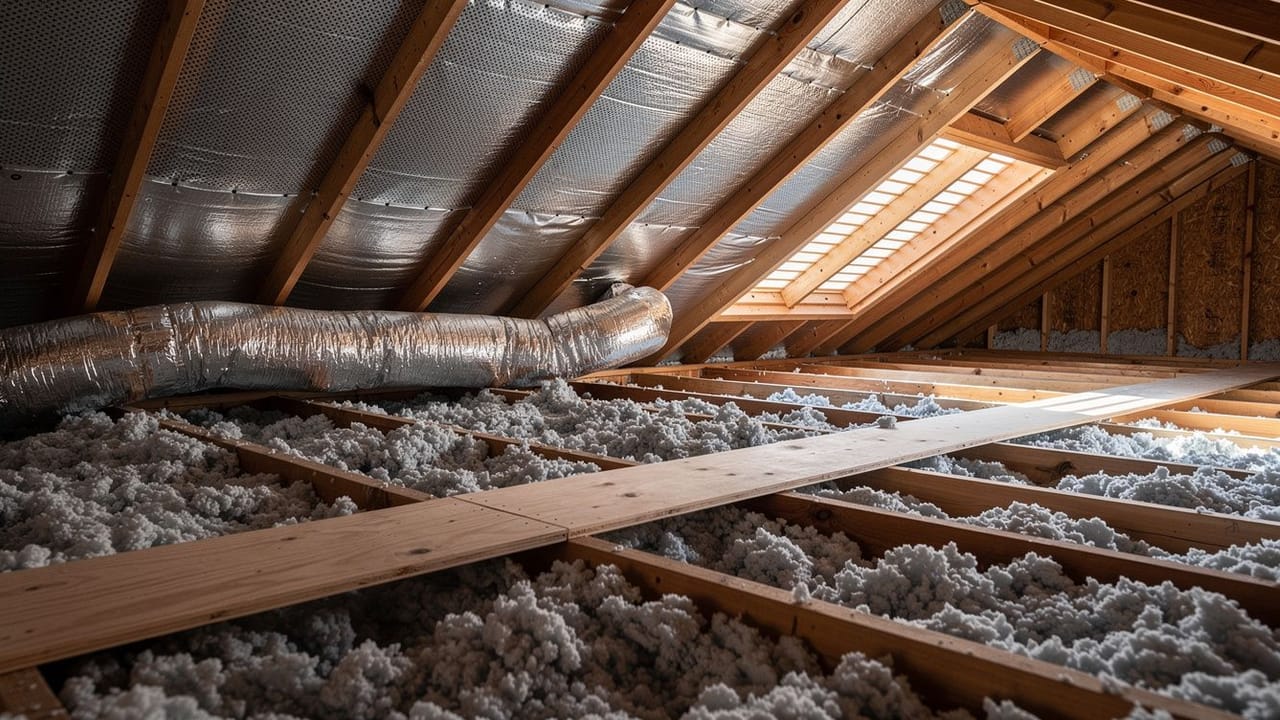
A radiant barrier is a sheet of reflective foil in the attic, and its job is heat radiating down off a sun-baked roof deck. Whether it’s worth adding to a Middle Tennessee house depends on the attic, the ducts and what’s already up there, and it goes in after the insulation, never in place of it.
What does a radiant barrier do?
The foil is hung from the rafters with open air beneath it, so heat radiating off a hot roof deck is turned back before it lands on the insulation and the ceiling below. Texas A&M engineers who modeled a dusty barrier in an attic treated it as one surface trading radiant heat with the others around it, roof deck included.
How much that helps varies a lot. An Oak Ridge National Laboratory analysis written for the 2010 update of the radiant barrier fact sheet found the benefit depends on the climate, the attic’s geometry, how the ducts are arranged and other details of the building. That’s why we won’t put a figure on what a barrier will do for your attic before we’ve been up in it.
What they do not
A barrier isn’t insulation. ENERGY STAR’s page on why to seal and insulate says insulation helps keep a house warm in winter and cool in summer. The foil deals only with radiant heat off the roof, so we treat it as a summer measure and don’t count on it in January.
Dust is the other weakness. In the Texas A&M lab work, the effective emissivity of an aluminum barrier rose in a straight line as more of its surface was covered with dust, which means a dusty face reflects less. They applied the dust deliberately and measured it, so the result says dust costs you something, not that a dusty barrier quits altogether. It’s one reason we’d hang the foil from the rafters rather than lay it face up over the insulation.
- Bought for summer roof heat, not for winter
- Hung with open air below the reflective face
- Added after insulation, never instead of it
- Benefit depends on the attic and the duct layout
- Dust on the foil cuts what it reflects
Where does a radiant barrier help most?
A house with ductwork running through the attic is the first one we’d look at, since ORNL names duct arrangement as one of the things the benefit hangs on. If those ducts are leaking or bare, sealing and insulating the attic ductwork is worth more than any foil above them.
The other is an attic that’s already sealed and insulated to the depth a Nashville house needs. There a barrier is an extra on top of finished work, and it’s much easier to judge whether the extra is worth paying for.
Sequence matters
Seal first, then insulate, then think about foil. ENERGY STAR’s attic air sealing project puts the first two in that order, with EPA recommending the attic insulation project be done after the air sealing. The same program says 9 out of 10 homes in the U.S. are under-insulated, so most attics have a bigger gap to close before a barrier comes into it.
Once the air sealing and the attic insulation are done, a radiant barrier is a fair thing to ask about, particularly with ducts overhead. If you’d like us to go up and say which of the three your attic is short on, request a free estimate.
Sources
- Noboa, O’Neal and Turner (Texas A&M), A model of the effect of dust on the emissivity of radiant barriers (1994), OSTI — Barrier modeled as a surface exchanging radiant heat in the attic; effective emissivity rose linearly with dust coverage; dust applied in the lab
- Stovall et al. (Oak Ridge National Laboratory), Analysis in Support of the Radiant Barrier Fact Sheet 2010 Update, OSTI — Benefit depends on climate, attic geometry, duct arrangement and other building parameters
- ENERGY STAR (EPA), Why Seal and Insulate? — Insulation keeps a house warm in winter and cool in summer; 9 out of 10 U.S. homes are under-insulated
- ENERGY STAR (EPA), Attic Air Sealing Project — EPA recommends completing the attic insulation project after air sealing
FAQ
Radiant Barriers in a Nashville Attic — questions
Do radiant barriers work in Tennessee?
They can cut the heat a hot roof sends into the attic and into ductwork running through it, but by how much depends on the house. An Oak Ridge National Laboratory analysis found the benefit depends on the climate, the attic’s geometry and how the ducts are arranged, so there is no single answer for every Middle Tennessee attic. We treat a barrier as a summer measure and look at the ducts and the insulation before recommending one.
Should I install a radiant barrier instead of more insulation?
No. ENERGY STAR describes insulation as helping keep a house warm in winter and cool in summer, while a radiant barrier only deals with heat radiating off the roof deck. EPA also recommends sealing the attic’s air leaks before insulating it. Seal, insulate to the right depth, and then consider a barrier as an addition, especially if ductwork runs through the attic.
Does a radiant barrier need an air gap?
Plan on one. The foil should hang from the rafters with its reflective face looking into open attic air, not pressed against insulation or decking. Keep dust in mind too: in a Texas A&M lab study, the foil’s emissivity rose in step with how much of it was covered by dust, so a dusty barrier reflects less than a clean one.
How is a radiant barrier installed in an attic?
Last, after the attic floor is air sealed, insulated to depth and any ducts up there are sealed and insulated. The foil is fastened to the rafters with its reflective face looking down into open attic air. We avoid laying it face up over the insulation, because dust settles on a face-up sheet and a dusty face reflects less heat.